Trojan (闘いの挽歌 Tatakai no Banka, Requiem for Battle in Japan) is a 2D side-scrolling video game similar to Tiger Road. It was developed by Capcom and released in the United States in 1986 by Romstar. Trojan was ported to the NES and later included in game compilations Capcom Classics Collection (2005), Capcom Arcade Cabinet (2013) and Capcom Arcade Stadium (2021).
Gameplay
The arcade version can be played by up to two players alternating. The game's controls consist of an eight-way joystick and two action buttons. Similarly to Kung-Fu Master and Rush'n Attack, the player jumps by holding the joystick upwards instead of having a dedicated jump button like other side-scrolling action games. Instead, one button is used to swing the sword at enemies and the other to hold the shield to block enemy attacks, including projectiles such as throwing-knives and arrows. The shield can be held towards the player while standing or crouching, as well as upwards vertically and diagonally. Some enemies will throw magic balls which cause the player to lose their sword and shield if they block. During these instances, the player will fight barehanded, with the sword and shield buttons used to punch and kick respectively. The sword and shield will appear on-screen after some time, allowing the player to recover them. Power-ups include floating hearts that restore the player's health and jumping spots where the player can jump higher than usual.
The game consists of six stages, where the player will face the usual series of weak enemies, as well as a sub-boss at the middle of each stage and a boss at the end. The player is allowed to start the game at any of the six stages. However, the player must play through the entire game again after defeating the final boss, Achilles, in order to see the true ending (similarly to Ghosts 'n Goblins). The player can continue after a game over depending on the dip switch settings.
The NES version of Trojan features several significant changes to the game, such as the addition of new power-ups and hidden rooms, as well as an alternative versus mode, where two players compete against each other in a first-to-three-rounds match, making it Capcom's first attempt at the fighting game genre. Player 1 controls the main character, while Player 2 controls the enemy character, whose abilities are identical to the main character. While the version in Capcom Classics Collection Vol. 1 is a direct emulation of the original arcade game, it also allows the option to assign one of the action buttons for jumping in addition to using the directional pad or the analog stick.
Story
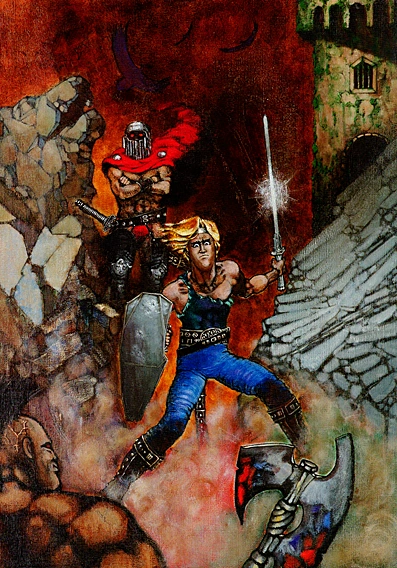

Key artwork.
The game is set in a post-apocalyptic world at the end of the century, following the end of nuclear war. The people of the world were oppressed by the tyrannical rule of an evil army, led by a powerful master known as Sword King Achilles. The people suffered under the army's regime, but dared not fight back out of fear of Achilles' power.[1][2]
The main character is a young wandering warrior known as Ryu the Hero Trojan, a fighter who has mastered all types of martial arts. He accepts a request from the frightened people to liberate them from Achilles' rule and bring peace back to the world, and so he embarks on a one-man quest against the evil army and Achilles.[1][2][3]
Characters
- Ryu the Hero Trojan (リュウ • ザ • ヒーロー • トロイア Ryū Za Hīrō Toroia) - The main character. A young wandering warrior who has mastered all forms of martial arts. Hearing the plea of help from the innocent people oppressed by Achilles and his men, Ryu takes up arms and goes to battle the evil army on a solitary mission to restore peace to the world. Ryu fights using a sword and shield, but if he loses them he can also defend himself by punching and kicking.[3]
Enemies
The main antagonists of the game are soldiers serving the evil army of Achilles, a powerful fighter known as the Sword King (剣王 Ken-ō). They have ruled over the lands with total impunity, oppressing the innocent people who can't or dare not fight back.
- Smasher (スマッシャー Sumasshā) - Fully armored thug with purple hair, the weakest type. Attacks with a spiked mace.
- Slash (スラッシュ Surasshu) - Slasher in the English NES version's manual. Soldiers wearing light armor (Arcade) o red armor (NES), they attack by throwing knives and magic balls that disarm Ryu.
- Road Diver (ロードダイバー Rōdo Daibā) - Hidden Archer in the English NES version's manual. Armed with a bowgun, these enemies come out of manholes and shoot at the player.
- Bomberman (ボンバーマン Bombāman) - Mad Bomber in the English NES version's manual. They come out of windows in the background to throw dynamite at the player. Can only be reached by super jumping.
- Red Arrow (レッドアロー Reddo Arrō) - Red Archer in the English NES version's manual. Similar to bombermen, Red Arrows come out of the top of rock formations to shoot at the player with their bowgun. Can only be reached by super jumping.
- Sky Gyro (スカイジャイロ Sukai Jairo) - Skyrogyro in the English NES version's manual. Men in gray armor that fly thanks to a rotor blade on their backs. They fly around above Ryu's head and drop bombs at him. Can only be reached by super jumping.
- Barbarian (バーバリアン Bābarian) - An enemy exclusive of the NES port. They come out of the swamp waters and attack by lunging and fire-breathing.
- Killer Fish (キラーフィッシュ Kirā Fisshu) - Killer Piranha in the English NES version's manual. An enemy exclusive of the NES port. Fishes that come out of the swamps in Stage 2 to attack Ryu.
Bosses
- Mamushi (マムシ) - Mamushi is the first boss of the first stage, and later returns as a recurring enemy throughout the game. Mamushi always appears in pairs, with four hit points apiece. They are slow and somewhat predictable and have very little defense. The danger comes from being sandwiched in and getting attacked from both directions. In the NES version, Mamushis appear wearing masks. The twin green-masked Mamushi serving as a boss are called the Mamushi Brothers (マムシ兄弟 Mamushi Kyōdai), while the weaker red-masked version is called Red Mamushi (アカマムシ Aka Mamushi), and they can throw their axe. In the English NES version's manual they are called Hatchet Brothers and Hatchetman respectively.
- Iron Arm (アイアンアーム Aian Āmu) - The second boss of the first stage. He is a little different depending on which version you are playing. In the arcade version, Iron Arm's eponymous limb simply extends quite a distance from his body before being retracted back into his arm. In the NES version, Iron Arm can actually launch him arm at the player, which rockets forward high or low to the other side of the screen, before returning at the opposite height back to Iron Arm.
- Armadillon (アルマジロン Arumajiron) - Armadillon is the first boss of the second stage. Fighting Armadillon requires a good deal of patience and attention. He has the ability to tuck himself up into a ball and roll across the ground. The only way to avoid getting hit by him is to jump over him as he approaches. After some time spent rolling around, he will stand back up and begin spit balls of fire. A weaker red Armadillon is encountered in the manhole of the second part of the first stage in the NES version.
- Goblin (ゴブリン Goburin) - The Hunchback in the English NES version's manual. The second boss of the second stage. He gets his name from his stooped over posture, but make no mistake, Goblin is very agile. He can leap all the way from one side of the screen to the other, and he typically uses this technique to escape from harm. He tosses shuriken, which must be dodged or blocked. In the NES version of the game, these shuriken can erupt into three bats that go flying around.
- Muscler (マッスラー Massurā) - Muscleman in the English NES version's manual. The first boss of the third stage. He appears differently in the two versions, but his behavior is pretty much the same. Muscular will attempt to get as close as he can before swinging a spiked mace (Arcade) or giant club (NES). He will swing several times before backing away and setting up for another strike. The best strategy to employ against Muscular is a quick swing and run away. One he is hit, get out of his range and let him finish up his attack before moving back in for another slash.
- Trojan (トロージャン Torōjan) - A skilled swordsman who has allied with Achilles, and seeks to eliminate the hero. He is the second boss of the third stage. He possesses all of the same sword and shield abilities as the player. He likes to perform jump attacks, which leaves him open to attack if quick enough. Since all health will return before moving on to the fourth stage, the player may attack a little recklessly. In the NES port, he is also the 2nd player character in VS mode.
- King Shriek (キングスリーク Kingu Surīku) - King Shriek is a pair of bosses exclusive to the NES version. Before the player reaches Achilles, there are two statues or warriors with flails carved into the wall. When both statues are in full view, the statues come alive, one at a time. As they do, bricks spray in every direction. The Shrieks are tall and swing their chained flail over their heads, making a jump attack hard to perform without getting hit. They try to slam the ball into the ground when approached. They each share a life bar, so when the first one loses four hit points and dies, the second one comes to life. They must both be defeated in order to advance to the final fight with Achilles in his chamber.
- Achilles (アキレス Akiresu) - The ultimate warrior and leader of the army, feared as the Sword King across the lands. Like Trojan, he possesses many of the same attack skills as the player, only he is much bigger and stronger. Timing attacks is key to taking down this ruthless tyrant. His attacks pack a lot of punch, so it is wise to stay out of his range. He is fairly susceptible to jump attacks.
Version differences
Four version of the arcade game were released at the time: One Japanese (Tatakai no Banka) and three Americans (Trojan).
- The first release is the US version, published directly by Capcom. This version allows the player to choose which stage they want to begin. In this version the enemy damage is static. The enemies and bosses can only real 2 of damage. In MAME there are two version of this release, Set 1 (trojan) and Set 2 (trojana). Between these versions, there are no differences.
- The second release is the Japanese version, published directly by Capcom. This version is known as Tatakai no Banka. The only two differences between the first US version is the game no longer let the player to choose which level they want to begin and this version of the game is absurdely hard. The enemy damage has changed to static to dynamic: Some enemies and bosses can deal 2 even 3 of damage.
- The third and last release is another US version, published by Romstar. This version retains the option of the level selection disabled from the Japanese version. Furthermore this is the easiest version of the game. The ememy damage it has returned from dynamic to static but is nerfed. Instead of deal 2/3 of damage, now the enemies and bosses deal only 1 of damage. making the bosses ridicolously weak and easier to beat.
Credits
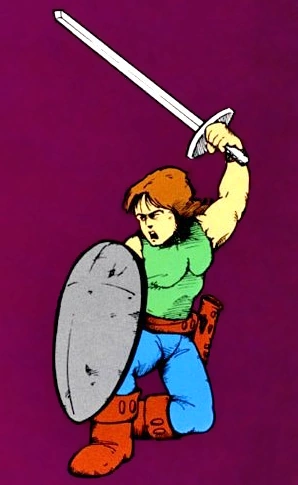

The protagonist of Trojan.
Arcade version
Trojan, like many other games during this era of gaming, credited its staff in its default Score Ranking Table, which is as follows:
- 1st 23600 Toshi.....
- 2nd 20000 Youichi...
- 3rd 18000 Yumiko....
- 4th 16000 Hiroyuki..
- 5th 12000 Midori....
- 6th 10000 Hatsumi...
- 7th 8000 Atsusi....
Additionally, the game's music is known to be composed by Ayako Mori, as confirmed by the liner notes of the Capcom Game Music album. Furthermore, a 1991 special feature[4] (Capcom: The Early Years, 1984 to 1990) confirms Youichi Egawa as a developer.
Gallery
Box art


Merchandise and advertisement


Trivia
- The main character of the game was given the name Ryu after its planner Takashi Nishiyama. This was the first of 4 playable characters named Ryu in reference to him: Trojan was followed by the player characters in Avenger, Street Fighter and Breath of Fire.[5]
- Although the option to select the level is disabled, in the Japanese and US (Romstar) version, the player can select the level in which to start. The player have to change it in the DIP switches.
- Normally, in the game over screen the continue theme is heard, leaving the game over theme unused. In order to hear the game over theme in arcade version, the player have to disable the continue option and lose all of his lives. Instead of the usual continue theme now the player can be hear the game over theme.
References
- ↑ 1.0 1.1 Arcade flyer for Trojan, English version.
- ↑ 2.0 2.1 Arcade flyer for Tatakai no Banka, Japanese version.
- ↑ 3.0 3.1 Manual for Tatakai no Banka for NES, Japanese version.
- ↑ Shmuplations: Capcom and the CPS-1 – Developer Interviews
- ↑ Akiman (December 28, 2010). Akiman's Twitter. Accessed January 25, 2023.