
Captain Commando (キャプテンコマンドー Kyaputen Komandō) is a 1991 futuristic side-scrolling beat 'em up game developed and published by Capcom as a coin-operated video game, and later ported to several other platforms.
It was the seventeenth title produced for the company's CP System hardware. The game stars the titular superhero, who was originally conceived as a fictional spokesman used by Capcom USA in the company's console games during the late 1980s[1], and his three members of the "Commando Team" as they fight against a gang of super-powered criminals.
Captain Commando is included in Capcom Classics Collection Vol. 2 (2005), Capcom Beat ’Em Up Bundle (2018), Capcom Arcade Stadium (2022) and it is also playable as an Arcade game within Street Fighter 6.
Gameplay
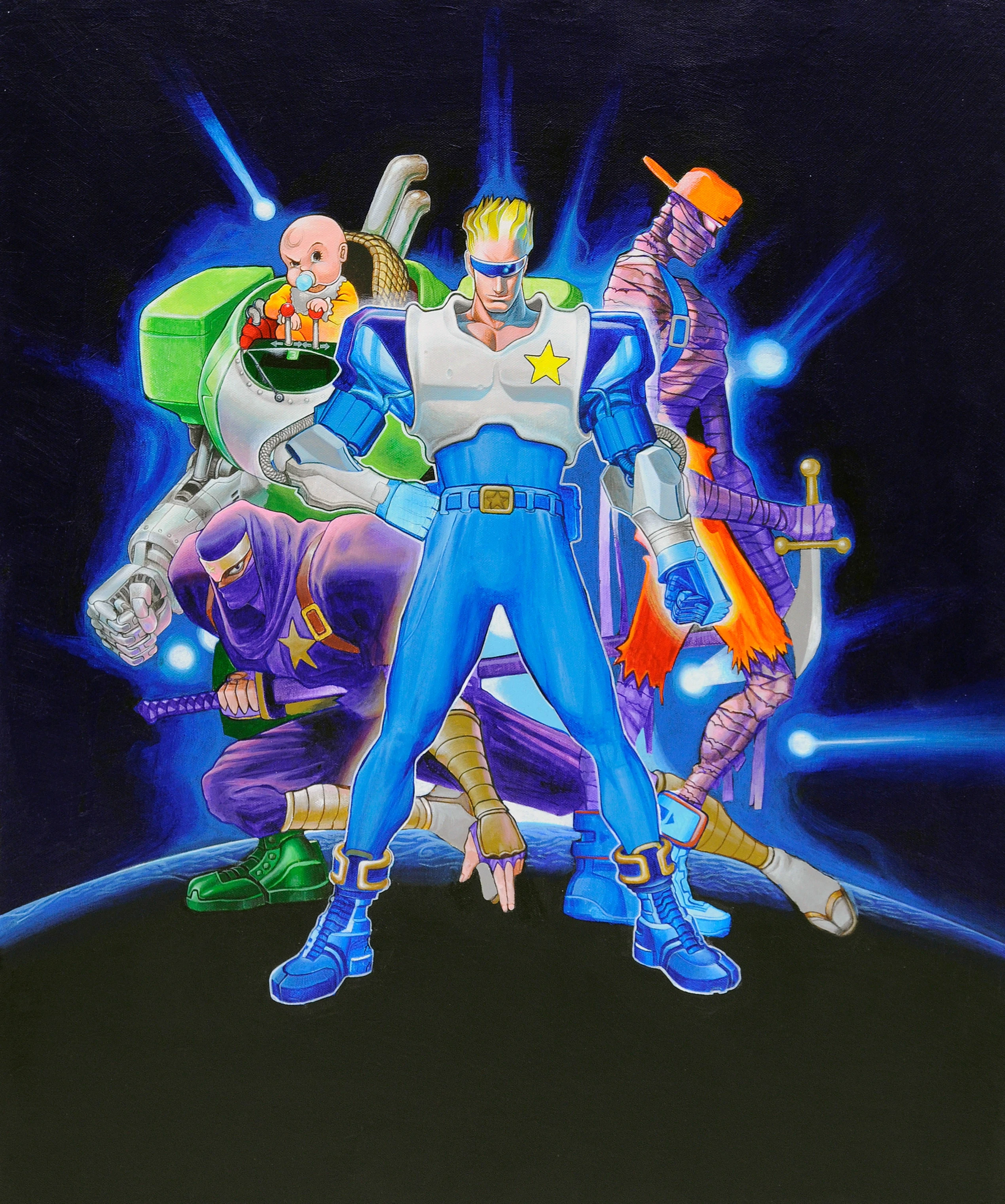

Key Artwork
Captain Commando follows the same gameplay established in Capcom's previous beat-'em-up Final Fight. The arcade version allows up to two, three, or even four players simultaneously depending on the game's settings. The player can select between any of the four "commandos" (Mack, Captain, Ginzu, or Baby-Head) as their character, with each player controlling a different character. The player's objective as usual is to move towards the end of each stage, defeat every adversary who gets in their way while avoiding any traps that they may throw at the player's way before eventually fighting the boss awaiting at the final area of each stage. The game consists of a total of nine stages.
The control configuration is exactly like Final Fight, with an eight-way joystick for moving the character left or right, as well as towards or away from the background, along with two action buttons for attacking and jumping. The player can perform numerous combination of attacks while standing or jumping, including grabbing the enemy, as well as a special attack by pressing the attack and jump simultaneously that will drain a portion of the player's vitality. An addition to the controls is the ability to dash by pushing the joystick left or right twice. The player can perform a running attack or even a running jump attack.
Like in Final Fight, the player can pick up health-restoring food items hidden inside barrels and other destructible objects to restore their vitality, as well as other bonus items to increase their score. Weapons also can be picked up, such as three different types of firearms, as well as shurikens that can only be used by Ginzu. Players also can ride certain robots by dismounting their riders and then jumping over the robot. The robots has their own vitality gauge and if they sustains enough damage, it will be destroyed. There are three types of robots in the game: a punching robot, a flame-throwing robot, and a freezing robot. Unlike Final Fight, weapons can be carried when the player makes the transition to a new area until the stage is completed.
Story
The game is set in the year 2026, in a crime-ridden city identified in secondary sources as being a future Metro City (the setting of Final Fight). Earth is suffering a wave of crimes perpetuated by criminals endowed with a secret hidden power (implied to be genetic tampering) which grants them abilities beyond that of ordinary mortals. The origin and leader of these so-called "Super Criminals" is Scumocide (known as Genocide in Japan), an evil genetic engineer aiming to rule not only Earth, but the whole galaxy.
With Earth completely overrun by these scourge, Captain Commando and his three faithful "Commando Companions" rise up to erase this criminal enterprise from both planet Earth and the whole galaxy. Concept art and other sources expand a bit on the background story of the main characters, for example revealing that Scumocide was behind the death of Captain Commando's parents, the desctruction of Mack the Knife's home planet and the circunstances that led Baby Head to become a baby.[2]
Characters
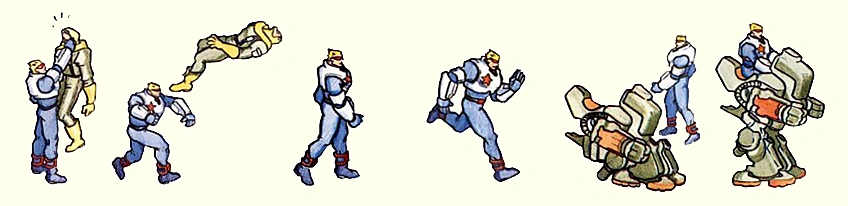

Art of arcade instructions.
Commando Team
The four playable characters, members of the Commando Team (コマンドーチーム Komandō Chīmu, Commando Companions in English media):
Enemies
The enemy force is known as Criminal Supermen (犯罪超人 Hanzai Chōjin) or Super Criminals, a group of people that have been granted superhuman abilities beyond ordinary mortals through genetic engineering. Scumocide's forces also include regular, non-enhanced criminals that work for him for a chance to become Super Criminals themselves.
- Wooky (ウーキー Ūkī) - Most basic enemy wearing green clothes and yellow hoods. Wookies consists mostly of street thugs kidnapped off the streets and enhanced to become Super Criminals. They have low intelligence and are treated as easily disposable. Akiman's unfinished manga shows a Wooky has enough physical strength to crush an adult man's head with their hands. In-game, Wookies can also ride robots.
- Eddy (エディ Edi) - Superior version of Wookies wearing purple clothes. They have knowledge of martial arts and greater strength, so their attacks are vastly improved.
- Dick (ディック Dikku) - Superior version of Wookies wearing blue clothes and a hat. They are experts in firearms, so they attack using weapons and can also pick them up if they appear on stage. They don't appear in the SNES version.
- Carol (キャロル Kyaroru) and Brenda (ブレンダ Burenda) - Elite Super Criminals wearing scantily-clad leather suits, Carol has pink hair and Brenda is blond. They fight using a sort of tuning fork that sends electric shocks. Their design was slightly altered to be less risque in the SNES port.
- Skip (スキップ Sukippu) and Sonie (ソニー Sonī) - Normal thugs hired by Scumocide due to their skills with knives. Skip uses a yellow jacket and Sonie a red jacket.
- Samson (サムソン Samuson) and Organo (オルガノ Orugano) - Regular humans that stand out due to their low intelligence and high aggressiveness. They look like bearded cavemen, with Samson wearing blue clothes and Organo red clothes.
- Marbin (マービン Mābin) - A small, bald obese man. He works for Scumocide wishing to become a Super Criminal one day. Marbin fights by doing a tackle and spitting fire.
- Mardia (マーディア Mādia) - A muscular, red haired-female fighter whose face is concealed by her hair. She attacks by projecting gobs of green slime that can melt anything they touch. In the SNES port, she throws bombs instead.
- Kojiro (コジロウ Kojirō) - Ninja wearing a red uniform, a loyal follower of Yamato. A melee-based enemy who attacks with punches and kicks. His name is based on Kojirō Sasaki.
- Sasuke (サスケ) - Ninja wearing a green uniform with no mask. An expert swordsman, he attacks with a katana and boasts to be as good as Ginzu wielding it. His name is based on Sasuke Sarutobi.
- Hanzo (ハンゾウ Hanzō) - Ninja wearing a blue uniform. An expert in the use of weapons, he attacks by wielding shuriken or bombs into battle. His name is based on Hanzō Hattori.
- Musashi (ムサシ Musashi) - A large samurai clad in brown armor with several arrows stuck to his back. He attacks with a katana, being able to block attacks but moving slowly in exchange. When low on health, the blade on his katana breaks off. His name is based on Musashi Miyamoto.
- Z (ズィー Zī) - A silver alien-like enemy with an elongated head and a pair of long claws for weapons. A very advanced enemy said to have a cutting-edge computer installed in his head, allowing him to easily identify and pursue enemies. Fights using large metal claws that can be shot forward.
Bosses
- Dolg (ドルグ Dorugu), boss of Stage 1: City. A former American Football player turned Super Criminal[3]. He is in the middle of robbing a bank when confronted. Dolg attacks by punching and doing a running tackle. He later reappears in Stage 9 as the last obstacle before reaching Scumocide.
- Shtrom Jr. (シュトゥルムJr. Shutorumu Junia), boss of Stage 2: Museum. A reptilian-like creature that fights using a speargun for long-range attacks. He moves very fast and can shoot one harpoon or several in quick succession, as well as perform a rolling jump into a drop kick.
- Yamato (ヤマト), boss of Stage 3: Ninja House. A rival ninja of the Bushinryu dressed in Kabuki gear and fighting with a naginata. He's the rival of Ginzu and has associated himself with Scumocide to become a Super Criminal[2]. He fights using his naginata to strike or by summoning other ninja to assist him.
- Monster (モンスター Monsutā), boss of Stage 4: Circus. A muscular green monster with three red eyes. He is first seen as a normal human in a tube before Dr. T.W transforms him in front of the Commando Team. Monster fights by stomping and rolling around, as well as shaking the screen to drop barrels from above.
- Dr. T.W (ドクターT.W Dokutā T.W), boss of Stage 5: Sea Port. A wicked scientist in league with Scumocide, he conducts experiments on innocent people. He attempts to escape via motor boat and the player has to defeat him in 40 seconds before he gets away. He is protected by Yamato's ninja and attacks mainly by throwing explosives in front and behind him. His full name is Dr. Tea Water (Dr. T・ウォーター Dokuta Tī Uōtā), which appears to reference the character of Professor Ochanomizu from Astro Boy, whose surname literally translates to "tea water".
- Shtrom (シュトゥルム Shutorumu) and Druk (ドラック Dorakku), dual bosses of Stage 6: Aquarium. They are palette-swaps of Sthrom Jr., blue for Shtrom and pink for Druk. Despite the name, whether there is a relationship between them is unknown. Sthrom and Druk fight together as a boss using Shtrom Jr.'s attacks. They share one life, however, so killing one takes out the other immediately. However, in the SNES/NSFC port of the game, this rule does not apply, they also appear one after the other, and you can beat them both as well, in fact, it is necessary to do so in order to go to Stage 7.
- Blood (ブラッド Buraddo), boss of Stage 7: Underground Base. A large muscular man whose arms are remodeled and enhanced, looking unnaturally big and dark as a result. Scumocide's right hand man, Blood stands as the leader of the operation on Earth. Blood fights by performing powerful kicks and a fast flying kick maneuver that covers the whole screen. In the SNES port his name was changed to Boots.
- Doppel (ドッペル Dopperu), boss of Stage 8: Enemy's Spaceship. A fat man in a green full-body tight suit. Through a remote control in his hand, he can mimic the form and attacks of the player's Commando character. If there are more than one player, then Doppel splits himself into the needed amount and transforms into every player. When fighting less than 4 players and reaching half-health, Doppel will split off and fight with one more copy than the number of players he faces (he turns into two if against 1 players, three if against 2 players and 4 if against 3 players), each clone adopting the form of a different member of the Commando Team.
- Scumocide (ジェノサイド Jenosaido, Genocide in Japan), final boss faced in Stage 9: Callisto. An evil genetic engineer with ambitions of ruling the galaxy, he created Super Criminals through genetic manipulation and enhanced them to become many times stronger and faster than ordinary humans. He has both killed Captain Commando's parents and destroyed Mack's home planet, and intends to use Mack's over-technology to rule all the galaxy. An imposing muscular man, he moves by floating and fights by using both fire and ice-based attacks, and can't be knocked down by normal attacks.
Minor Characters
- Dr. Alexander (Dr.アレクサンダー Dr. Arekusandā), A respected scientist and Captain Commando's father. He was a highly respected member of a research university. He helped Mack when he landed on Earth and in return Mack gave him access to his technology. He and a group of scientists secretly researched it, taking precautions to prevent it from failing into Scumocide's hands. Unfortunately, they were found out and the whole group was killed by Scumocide.[2]
- Elaine (エレーヌ Erenu), Captain Commando's mother and Alexander's wife. She died alongside her husband.[2]
- Gou (號 Gō), Ginzu's father, Guy's student and the 40th Grandmaster of Bushinryu. He served Commando's parents as a bodyguard.[2]
- Akane (あかね), Ginzu's younger sister and Gou's daughter[2]. No more information is given about her.
- The U.F.P., an organization attempting to fight back the rise of Super Criminals, with very limited success. A representative appears in the game's ending, standing in front of a large TV screen detailing the end of the criminal menace in town before Captain Commando hijacks the screen broadcast to confirm the death of Scumocide and the end of his criminal army.
- Secret Society (秘密結社 Himitsu Kessha), a mysterious secret group that has over 1000 years of history, and has complete control over the Earth Government. Scumocide is their current "successor" (後けい者 Kōkei-sha).[2]
- Earth Government (地球政府 Chikyū Seifu), the ruling body over Earth. Its president, while under control by the Secret Society, secretly supports Captain Commando as he held a lot of respect for his father, Dr. Alexander.[2]
Captain Commando manga
A manga based on Captain Commando was released in 1994 as part of the "Gamest Comic" imprint, serving as promotion for the SNES port. The manga was written by Kenkou Tabuchi (田渕健康) and drawn by Kotomi Tobashi (戸橋ことみ). It lasted 14 chapters before being cancelled, leaving most of the plot on an unresolved cliffhanger, with the manga later rereleased in two volumes. UDON Entertainment released an English translated version in 2011, including unreleased chapters (up to chapter 23), finishing Baby Head's backstory but still leaving most of the main story incomplete. The manga is an adaptation that greatly expands and alters the background story created for the game, introducing new characters as well as expanding the role of a few minor enemies in the plot, while also altering major details of the backstory written for the game.
The most notable change is that the antagonist group of Super Criminals is called "Scumocide" (after its leader), and its revealed to be a social darwinist-type organization that believes in strength over everything else and looks down on the weak as simple fodder to be ruled over and disposed. Other changes include Carol and Brenda becoming mafia lords of Metro City known as the Basia sisters; Mardia being a member of Yamato's ninja group, his second in command and being in love with him; and Ginzu's sister Akane making an actual appearance as a Bushinryu ninja-in-training that's also Captain Commando's childhood friend, and an adept fighter using a Sansetsukon or three-sectioned staff in battle. Captain Commando is given a civilian identity as "Mars Carlisle", and four characters are given full names: Ginzu Takegami (武神 翔 Takegami Sho), Akane Takegami (武神 茜), Yamato Mikagura (御神楽 大和) and Hoover J. Estefan (given in English on a monitor screen)
For the expanded roles of each member of the Commando Team, check their individual pages.
Original characters
- Sarah Kisaragi (サラ・キサラギ) - A reporter obssessed with covering the rumored vigilante super-hero Captain Commando. After being rescued by him in an attempted museum robbery, she becomes determined to expose Mars Carlisle as the real identity of Captain Commando, something that puts her at odds with both Mack and Mars' assistant Aya. Eventually she realizes why Mars uses a secret identity and abandons the idea, becoming a vital help to the Commando Team.
- Aya Maverick (アヤ・マーベリック Aya Māberikku) - Mars Carlisle's assistant in Star Electronics, who has to wrestle with Mars' lazyness and tendency to bail, and the risks he takes as Captain Commando. Aya is adept at martial arts and has a determined personality, but she falls far behind most enemies the Commando Team deal with.
- Albert (アルバート Arubāto) - Mars' family butler who raised him after his parents' death. An obvious pastiche of Alfred Pennyworth from Batman.
- Mercenary Group Z - The generic enemy Z is reimagined as a mercenary group named "Z", because it represents the end of the alphabet, and of the lives of their targets. The group is made up of 4 members:
- Lagmin: A blond man with an arrogant and bloodthirsty personality, always wanting to fight. He is the only member seen carrying the long claws used by the Z enemy in the game.
- Faibos: A dark-skinned fighter with a scar over one of his eyes. He's cool and down-to-earth, often the one reeling back Lag when he gets too excited in a fight.
- Sandy: A blond woman with a serious personality. She starts acting odd at the end of the manga, creeping Lag in the process, but the manga was cancelled before what happened to her was revealed.
- A fourth member whose name was not revealed, a black-haired woman who works closely with Blood.
- T-91 (ティ・ナインティーンワン Tī Naintīnwan) or Tina (ティーナ Tīna) - A little girl that was created artificially by Dr. Hoover and Dr. T.W as part of Project Try Hanyiel. She was initially kidnapped by Dr. T.W after he fatally wounded Hoover and set the lab on fire, forcing him to transfer his mind into the Baby Head body. Years later, Tina manages to escape and bonds with Sarah, who attempts to protect her from T.W's assistants seeking to reclaim her. She is shown to have some kind of psychic powers, and Dr. T.W referred to her as a weapon, but the story was cancelled before anything about her nature was revealed.
Akiman's unfinished manga
Unrelated to the manga above, this refers to a manga project by Akiman that was to show events from before the beginning of the game, but the manga was never finished nor published. Only 5 color pages were published in artbooks years later, showing Dolg and a number of Wookies and Carol assaulting a laboratory or institute and taking the scientists hostage. As the apparent head scientist refuses to cooperate, Dolg has a Wookie crush one of the hostage's head with his bare hands, and this makes another scientist in line so scared he points to a woman among them. Despite this, he's still killed when Carol kiss him, using her electric weapons to electrocute him to death. As these pages lack in all dialogues, it's unknown what is happening, but it is possible this is depicting the moment Dr. Alexander's research group is annihilated by Scumocide's men.
The physical artbook included as part of the Complete Box limited edition of the Capcom Beat'Em Up Bundle prints all 5 manga pages with fully restored dialogue, although the artbook was only released in Japan.
Development
Captain Commando saw life first during the Eighties as a spokesperson created by Capcom USA[1]. He appeared in packaging and game manuals for many of Capcom's earlier titles for the Nintendo Entertainment System released between 1986 and 1988, including 1942, Commando, Ghosts 'n Goblins, Mega Man and Gun.Smoke, all as part of a brand called the "Captain Commando Challenge Series", with a "Special Message" from Commando congratulating the player for purchasing one of Capcom's products. The packaging also featured an image of the Captain with a design reminiscent of a futuristic space hero with a "western sheriff" theme, holding a raygun in each hand.
Captain Commando returned in a revised version for Capcom's NES lineup in 1989 (Strider, Mega Man 2, Willow and DuckTales). This included a new appearance for the Captain, now drawn in a more realistic style as a space pilot of sorts in front of a fighter jet, wearing a white space suit with a holding helmet, and an alien monkey sitting on his right shoulder. The text above the artwork featured a message from the Captain advising the reader to "look to (him) for up-to-date reports for all the exciting action games from Capcom", followed by the Captain's apparent handwritten signature.
Captain Commando wouldn't surface again until 1991, when Akiman decided to bring him back as the main character in a game of his own. Thinking of his previous designs as "not cool"[1], Akiman decided to redesign the character entirely inspired by American comic book aesthetics, creating the current iconic design for the character.[4]
Reception
In Japan, Game Machine listed Captain Commando on their December 1, 1991 issue as being the most-successful table arcade unit of the year, outperforming titles such as Street Fighter II: The World Warrior and WWF WrestleFest.[5]
On release, Famicom Tsūshin scored the Super Famicom version of the game a 21 out of 40.[6] In 2013, the arcade original game was ranked as the 21st top beat 'em up video game of all time by Heavy.com.[7]
Other appearances
- Captain Commando, Ginzu and Carol appear as background characters in Ken's stage from Street Fighter Alpha 2, attending as guests to the birthday of Ken's girlfriend (and future wife) Eliza.
- The four members of the Commando Team alongside Scumocide, Carol, Wooky (inside a Ride Armor), Marbin and Dr. T.W (with Monster) appear in the quiz game Adventure Quiz: Capcom World 2.
- Captain Commando most famously is a playable character in Marvel vs. Capcom: Clash of Super Heroes and Marvel vs. Capcom 2: New Age of Heroes. One of his special moves summon the members of the team to perform an assist attack: Ginzu comes down with a katana strike, Mack does a spinning attack flying above his head and Baby Head drops down and shoots a missile forward.
- The four members of the Commando Team appear as playable characters in Namco x Capcom, with Sthrom, Sthrom Jr. and Druk serving as bosses and Z, Carol and Brenda working as enemy units. Doppel also appears as an enemy unit, albeit never in his original form, instead appearing already transformed into clones of playable characters.
- The Commando Team also appear as a card in the Heroes and Heralds mode of Ultimate Marvel vs. Capcom 3 and as separate cards in all three entries in the SNK vs. Capcom: Card Fighters series.
- Captain Commando returns as an Assist Unit in the Namco x Capcom sequel Project X Zone 2. Shtrom, Shtrom Jr. and Druk return as minor bosses; with Carol, Brenda, Wooky, Eddy and Z appearing as enemy units.
- Captain Commando appears as a costume for Chuck Greene in Dead Rising 3, Charlie Nash in Street Fighter V and Frank West in Dead Rising 4.
- All four members of the Commando Team appear as playable units in the cancelled game Capcom Super League Online.
- Carol appears as one of the target NPCs to fight in "The Fighty Mighty" sidequest from World Tour mode in Street Fighter 6. Ginzu's father Gou also makes his first official video game appearance in one of Kimberly's flashback images, where she met and was defeated by him.
- In June 2024 an official Capcom collaboration with Chinese mobile game Langrisser Mobile was announced to feature the main characters of Captain Commando, appearing in the strategy RPG as two dual units: Captain Commando and Baby Head in one, and Ginzu and Mack in the other.[8]
Trivia
- Captain Commando is generally assumed to take place in the future of the Street Fighter universe due to its numerous references to Final Fight, such as being set in Metro City and Ginzu being mentioned to have been trained in Bushinryu. However, in Yuta Homura's profile on the Shadaloo Combat Research Institute states he can do a no-death/single credit run with Mack the Knife[9]. Although this may draw the connection into question, it is worth noting "Captain Commando" is never stated to be the name of the game, only described generically as a "beat'em up action game". Gou's appearance in Street Fighter 6 later becomes the first in-story reference in Street Fighter to Captain Commando.
- One of the possible score-up items the player can find in-game is a bust of Mike Haggar, former mayor of Metro City, which awards 5000 points.
- Captain Commando was listed as the main character in the English manual of Section Z for the NES. The text is somewhat ambigious about it, as it claims "Freedom Fighter" Captain Commando unites with the game's player, who is described as having "shed his earthly identity to become the last remaining astronaut in space", a description fitting of the nameless astronaut player in the Japanese version.
- 52toys announced in 2022 an official line of 3.75″ figures of the four members of the Commando Team, alongside figures from Dynasty Wars/Destiny of an Emperor[10], later released in late 2023. This is the 2nd official Captain Commando figure following a Captain Commando action figure that was part of a Marvel vs. Capcom: Clash of Super Heroes set by ToyBiz.
Credits
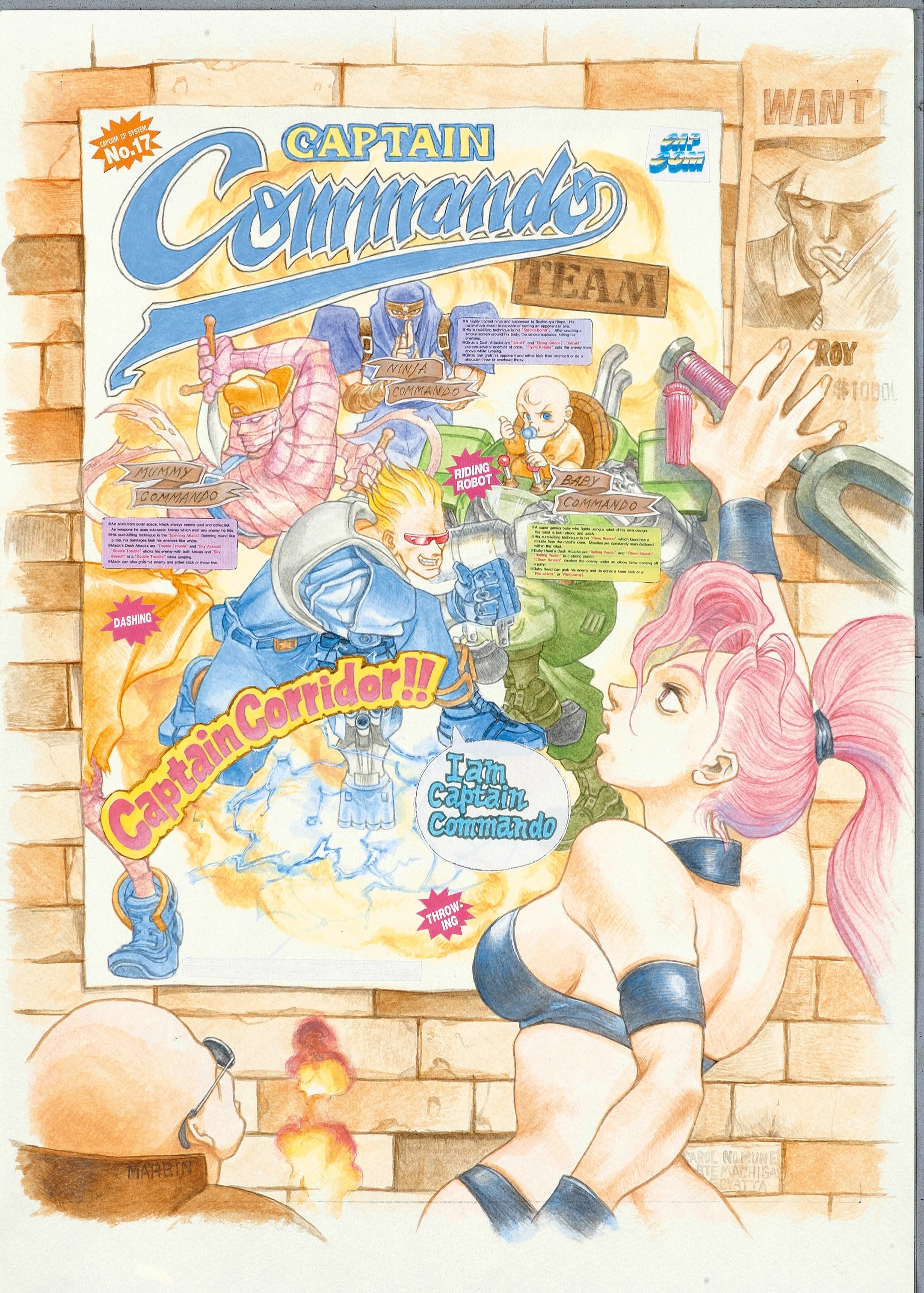

Fan Club artwork.
Arcade Version [Staff]
- Planner: Akiman, Ohno
- & Sub Planner: Gyo
- Character Design:
- Object: Kurisan, Ouji, Eripyon, Mattian, Q, Mayo, Ykaru M
- Scroll: Koi, Powerful Konomi, Sui, Buppo, Go
- Editorial Design: Sho
- Programmer: Egawa, Yokoyama, Ueno, Yoshizumi
- Sound: T Yomage
- & Sound Sub: Syun
- Special Thanks: James, Scott, Tetsu, Nin
Additionally, some of the game's staff is credited in its default Ranking Display table, which is as follows:
- 1st EGW 59000
- 2nd OHO 58000
- 3rd YOS 57000
- 4th UEN 56000
- 5th YOK 55000
- 6th IZU 54000
- 7th CPS 53000
- 8th CAP 52000
- 9th COM 51000
- 10th ABC 50000
SNES Version
Though no credits exist for this version, the Ranking Display table from the arcade version is slightly reworked for this version as follows:
- 1st EGW 123860
- 2nd OHO 78520
- 3rd YOS 63340
- 4th UEN 52100
- 5th YOK 52000
- 6th IZU 49320
- 7th CPS 46210
- 8th CAP 44480
- 9th COM 32150
- 10th ABC 25200
PSX Version [PlayStation Staff]
- Executive Producer: Yasuyuki Narushima
- Chief Programmer: Seiji Hasegawa
- Music Composer: Hiroshi Kuronuma, Naoki Tsuchiya
- Sound Effect: Naoki Tsuchiya
- Booklet Designer: Yasuyuki Narushima
- Special Thanks: Katsuyoshi Yamaki, Toru Suzukawa, Kiyoshi Sakurai, Ryuta Aoyagi, Toshiki Matsumoto, Akira Nomoto, Toshikazu Hamaya, Takatsugu Okamura
- Test Player: Hiromichi Narushima, Keiko Yamamoto, Koutaro Shimane, Youhei Tanaka, Yoshitaka Morishige, Isao Yoshihara, Hazuki Shimane, Sayuri Tsuda
See also
Gallery
Character artwork


Box art


Merchandise and media


Videos
References
- ↑ 1.0 1.1 1.2 Akiman (August 24, 2018). "Akiman's twitter" (Japanese). Accessed July 21, 2023
- ↑ 2.0 2.1 2.2 2.3 2.4 2.5 2.6 2.7 Captain Commando Game Staff (1996). "Capcom Gamest Mook Vol. 17: Capcom Illustrations". Shinseisha. Pg. 95
- ↑ Concept art from the Captain Commando gallery featured in Capcom Beat ’Em Up Bundle.
- ↑ Akiman (March 1, 2020). "Akiman's twitter" (Japanese). Accessed July 21, 2023
- ↑ cite magazine|last=|first=|title=Game Machine's Best Hit Games 25 - テーブル型TVゲーム機 (Table Videos)|magazine=Game Machine|issue=416|publisher=Amusement Press, Inc.|date=1 December 1991|page=25|lang=ja
- ↑ NEW GAMES CROSS REVIEW: キャプテン コマンドー. Weekly Famicom Tsūshin. No.327. Pg.40. 24 March 1995.
- ↑ The Top 25 Beat 'Em Up Video Games - Part 1 | HEAVY
- ↑ Post in the Langrisser Mobile Official Group Facebook from June 26, 2024
- ↑ Yuta Homura's Street Fighter V website profile
- ↑ Moore, Joey (May 25, 2022). "Captain Commando and Destiny of an Emperor Figures by 52Toys" (English). 'www.toyark.com. Accessed February 24, 2024)