Mega Man III (Rockman World III in Japan), produced by Tokuro Fujiwara, is a Game Boy game in the classic Mega Man classic series of action platformer games. It is the third game in the Rockman World games and was originally released in 1992 for the Game Boy.
Gameplay
This section is currently incomplete.
You can help Capcom Database by expanding it.
Characters
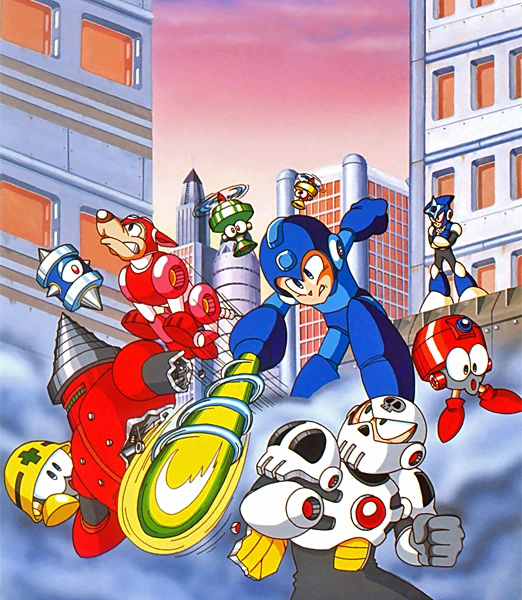
Japan cover art
- Mega Man
- Rush
- Eddie
- Dr. Wily
- Snake Man
- Gemini Man
- Shadow Man
- Spark Man
- Dust Man
- Skull Man
- Dive Man
- Drill Man
- Battontons
- Punk - A street-fighting bully who fears nothing and no one. He believes the only way to win is by not following the rules, and his allies are weary of his back-stabbing habits. Punk's weapon is the Screw Crusher, a motorized saw blade. He can also reconfigure himself into a soaring saw blade, by locking himself into his indestructible shell. Dr. Wily keeps a close eye on him, to prevent any kind of untimely betrayal. Punk later appeared in Mega Man V and Mega Man 10.
Story
After the last defeat, Dr. Wily goes into hiding and isn't heard from for many months. That is, until the government discovers a top secret underwater mining operation set up by the dastardly doc. The government calls Mega Man to stop him before he can get what he needs---energy from the earth's magma so he can create his newest battle robot---and use it for his evil purposes. Meanwhile, Dr. Wily has created a tough robot named Punk, who has a single purpose: destroy Mega Man at all costs.
Credits
As with the rest of the classic Mega Man series titles released for Game Boy, the game lacks a credits sequence for the game's staff and instead offers a "cast roll" for the game's characters.
For this title, all of the sound duties (music composition [including original stage BGM], music arrangement, sound effects, porting and driving/programming) were primarily handled by one man: freelance sound designer Kouji Murata. He was contracted through Minakuchi Engineering (following his work with said company on the Game Boy edition of Bionic Commando) and would later return for the next entry in the series. All of this is stated on the respective entry(ies) on Murata's official worklist,[1] where he also recounts being praised for the success of the game's soundtrack in light of the series' previous entry.
Another audio designer involved with this title was fellow Minakuchi Engineering composer Toru Osada (of Solar Striker fame), whose Facebook had noted in the early 2010s that he was involved with "GB Rockman World 3 sound program, sound transplant, composition, sound effects" (originally written in Japanese), as noted on a VGMDb forum.[2] This information, however, was never archived and has since been lost to site design updates. This is of particular significance because Osada is presumed to have been involved with the first Game Boy title in the series despite the known copyright record, as noted in places such as VGMPF.[3]
Gallery


Box art


Merchandise and advertisement


References
External links